
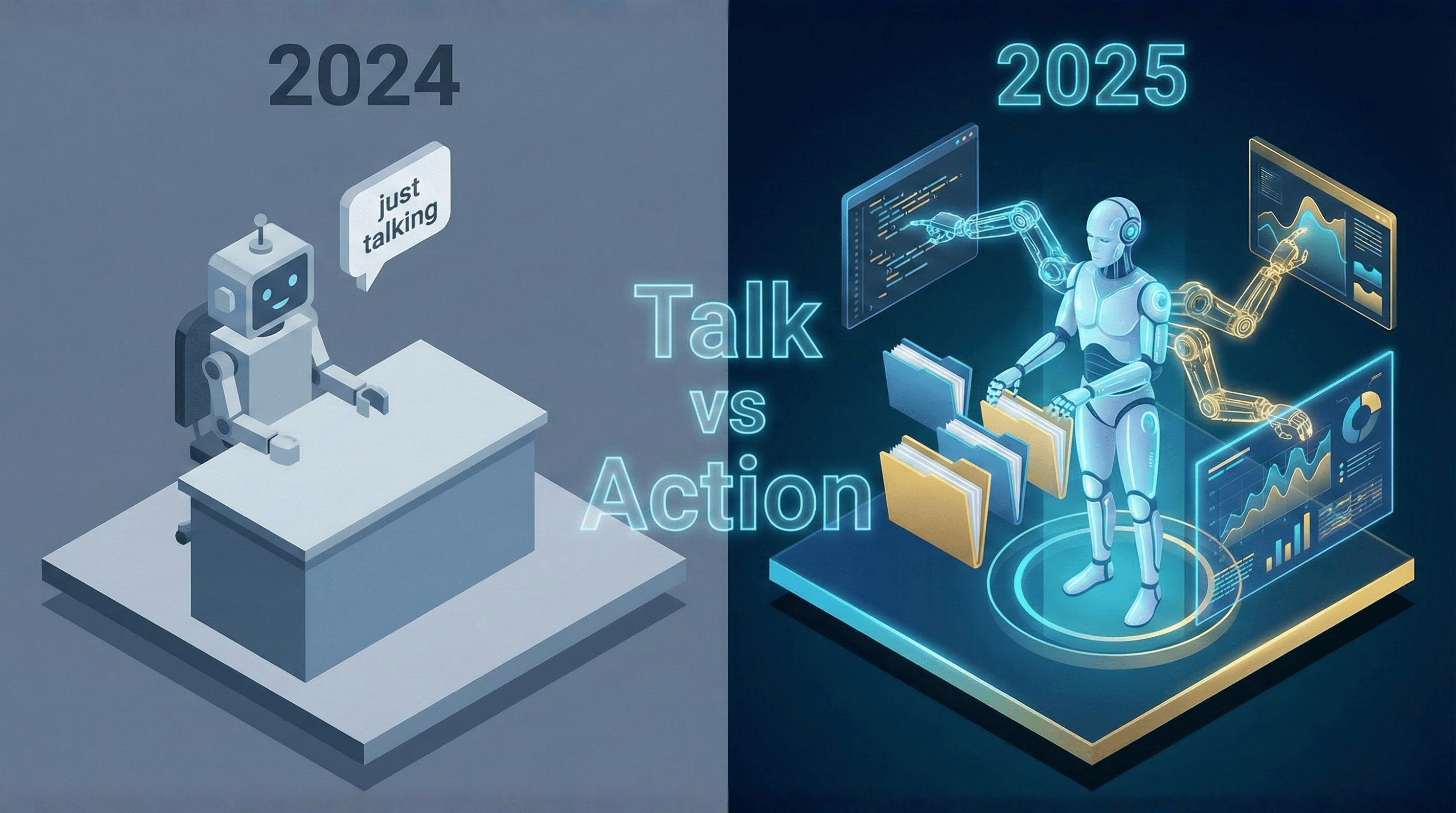
Remember when ChatGPT first dropped, and we were all blown away by its ability to write poems and debug code? That was 2023. Fast forward to 2025, and the conversation in Silicon Valley has shifted dramatically. The era of “Chatbots” that just talk is fading. We are now entering the era of “Agents” that actually work.
If you’re a startup founder, an investor, or just a tech enthusiast trying to keep up, you need to understand this pivot. It’s no longer about generative artificial intelligence creating text or images. It’s about Agentic AI executing complex workflows autonomously.
Think of it this way: Generative AI is like a brilliant intern who can answer any question but sits at their desk waiting for instructions. Agentic AI, on the other hand, is like a seasoned manager. You give them a goal “Plan a marketing campaign” and they go out, research competitors, draft emails, schedule posts, and analyze the results, all without you holding their hand.
This shift from “Talk” to “Action” is why venture capitalists (VCs) are redirecting their billions from LLM builders to agentic startups. Let’s dive deep into why this is happening and what it means for the future of the enterprise workforce.
The Problem with “Just Chatting”
For the past two years, enterprises have been experimenting with GenAI. The results? Mixed. Sure, drafting emails is faster, but the real bottleneck in business isn’t writing; it’s doing.
A chatbot can tell you how to book a flight. An autonomous agent can actually book the flight, add it to your calendar, and expense it to your company card.
The limitation of standard LLMs (Large Language Models) is that they are passive. They require constant prompting. This “human-in-the-loop” necessity limits scalability. Businesses don’t just want a smarter search engine; they want automation that works while they sleep. This demand is driving the explosion of agentic AI vs generative AI solutions.
2025: The Year of the “AI Employee”
We are seeing a surge in startups building what can only be described as “AI Employees.” These are software agents designed to take over entire job functions, not just tasks.
Take Reflection AI, for example. This startup recently made headlines not for building a better chatbot, but for creating agents that can autonomously navigate web browsers, use software tools, and complete multi-step workflows.
Or look at the sales sector. Startups are deploying agents that don’t just draft cold emails but also research prospects on LinkedIn, customize the outreach, handle the back-and-forth scheduling, and update the CRM (Customer Relationship Management) system.
This isn’t sci-fi. It’s happening now. The promise of artificial general intelligence (AGI), where AI can do anything a human can do is still a distant dream, but Agentic AI is a significant practical step towards it. It bridges the gap between “intelligence” and “utility.”
Follow the Money: Why VCs Love Agents
If you want to know where the future is heading, follow the money. In 2024, AI funding was largely concentrated on the foundational model layer (OpenAI, Anthropic, Mistral). In 2025, the capital is flowing up the stack to the application layer, specifically to agentic workflows.
Why? Because the unit economics make sense. Selling a chatbot subscription for $20/month is fine. But selling a “Digital SDR (Sales Development Representative)” that can replace a $60,000/year employee for a fraction of the cost? That’s a billion-dollar opportunity.
Investors are betting that Agentic AI will be the key to unlocking the massive B2B productivity market. We are seeing valuations soar for startups that can prove their agents can handle ambiguity and recover from errors without human intervention the two biggest hurdles for automation.
The Challenges: Trust and Control
Of course, handing over the keys to an AI agent isn’t without risks. When an AI just writes a bad poem, it’s funny. When an AI agent accidentally deletes a production database or sends an offensive email to a client, it’s a catastrophe.
“Hallucination” in a chatbot is a nuisance. “Hallucination” in an autonomous agent is a liability.
This is why the next wave of successful startups won’t just be building agents; they will be building the “guardrails” and “management layers” for these agents. We will see the rise of observability tools that allow humans to monitor, audit, and intervene in agent actions.
Prepare for the Agentic Workforce
The transition to Agentic AI is inevitable. It represents the maturation of the AI industry from a novelty to a utility. For businesses, the question is no longer “How can we use AI to create content?” but “How can we use AI to execute work?”
If you are building a startup in 2025, don’t build another wrapper around ChatGPT. Build an agent that solves a painful, expensive problem end-to-end.
To stay updated on the latest shifts in the global startup ecosystem and investment trends, keep an eye on the Startup and Business channel on Uzone.id. The workforce is changing, and the agents are here to stay.

